
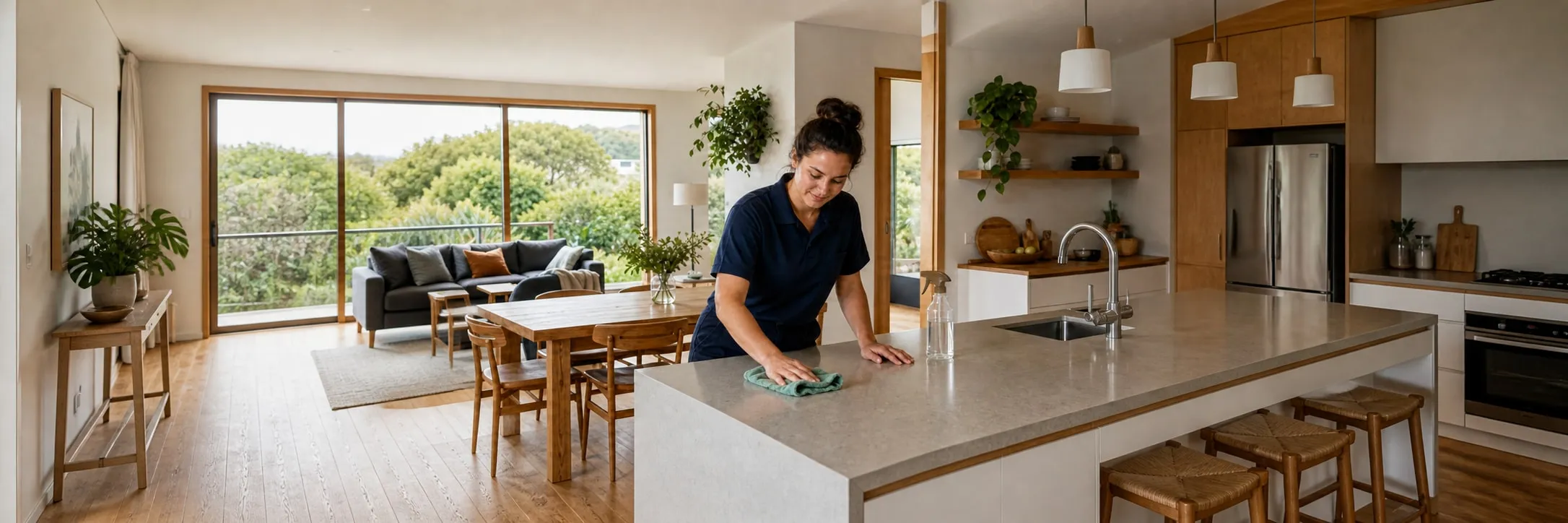
Nobody really cleans their house on a schedule. You clean when the bench starts to annoy you, when someone's coming over, or when you finally notice what's happened to the shower. That works for years, right up until it doesn't, and you're looking at a house that needs a full day you haven't got. The honest answer to how often you should clean your house is that it depends far more on the house and who's living in it than on any schedule you'll find online. There's still a rhythm worth aiming at, though.
Here's the short version, then the detail.
For most homes: kitchen and bathrooms get a light reset weekly, floors weekly or fortnightly, bedrooms and living areas fortnightly, and the whole house gets a proper top-to-bottom clean two or three times a year. Push it harder if you've got pets, young kids, allergies or a house that holds damp. Ease off if you're out all day and you tidy as you go. The rhythm matters more than the frequency, because a smaller clean you'll actually do beats a thorough one you keep putting off.
What actually sets the frequency
Two houses the same size can need completely different rhythms, and it's usually got nothing to do with how house-proud anyone is.
Who's in the house. A couple who both work out of the house is a different job to four people, two of them under five. Small kids move the kitchen and the bathroom floor into the daily column on their own.
Pets. A shedding dog or an indoor cat turns vacuuming from a weekly job into an every-few-days one, and it's the main thing that drags carpets and soft furnishings forward.
Whether shoes come off at the door. This one is close to free and it makes a bigger difference than any product. A shoes-off house keeps its floors and carpets looking right for far longer.
How the house breathes. A sunny, airy place stays fresher on less work. A shaded, closed-up one needs more attention, especially over winter.
Your surfaces. Dark benchtops, glass shower screens and matte black tapware show everything. This one surprises people. We clean plenty of near-identical townhouses where one kitchen still looks fine after a week and the next shows every mark by Tuesday, and the difference is a dark benchtop sitting under a downlight.
How often to clean your house, room by room
None of this is a rule. It's the rhythm that stops a house ever needing a rescue, which is a much easier job than catching one up.
Every few days
- Kitchen bench and sink wiped down
- Dishes cleared rather than stacked
- A quick wipe of the bathroom basin and mirror
- High-traffic floors swept or vacuumed, if you've got pets or kids
Weekly
- Toilets, showers and baths cleaned properly
- Kitchen splashback, cooktop and the fronts of the appliances
- Floors vacuumed and mopped right through
- Bins emptied, and the kitchen bin itself wiped out
- Sheets changed
- Window sills and channels dried, especially through winter
Fortnightly
- Dusting: shelves, sills, skirting boards, tops of door frames
- Inside the microwave
- Mirrors and interior glass
- Bedrooms and spare rooms vacuumed, including under the beds
- Towels and bath mats washed
Monthly
- Rangehood filter degreased
- Fridge shelves wiped out
- Dishwasher and washing machine filters cleared
- Extractor fan covers wiped
- Light fittings and switches
- Under and behind whatever furniture moves easily
Two or three times a year
- Inside the oven
- Inside cupboards and the pantry
- Windows, inside and out
- Curtains and blinds
- Walls spot-cleaned, plus doors and frames
- Carpets, if they're actually due
How often to deep clean on top
A deep clean isn't a bigger version of your weekly clean. It's a different job: the things that never come up in a normal week. Inside the oven, the rangehood filter, inside cupboards, skirting boards, door frames, window tracks, and behind or under whatever can be moved. Our guide on regular vs deep cleaning lays out exactly where that line sits.
Twice a year suits most homes. Three or four times if you've got pets, small children, someone with allergies, or a place that runs damp. Once a year is genuinely fine for a quiet household that stays on top of the weekly stuff. If you're booking one in, a deep clean is scoped for precisely this and it's the sensible thing to start with.
Starting a regular clean on a house that needed a deep clean first. The early visits get spent catching up on months of build-up instead of maintaining, and it reads as the clean not working when really it was just the wrong starting point. If the house is overdue, do one deep clean to set the line, then let the regular visits hold it. That works out cheaper than paying for catch-up every fortnight.
Weekly, fortnightly or monthly
If you're bringing someone in, this is the question that actually gets asked, and the answer is less about the house than about what you want to stop thinking about.
Weekly suits a full house, pets, long working hours, or anyone who'd rather the place never drifts. Nothing builds up, so each visit is maintenance rather than recovery.
Fortnightly is where most households land, and it holds fine as long as you're doing the every-few-days basics between visits.
Monthly is a top-up rather than maintenance. A month is long enough for bathrooms and floors to get away on you, so the visit ends up heavier and you feel the gap in week four.
Plenty of people book weekly when fortnightly would hold fine. If the house isn't full and you tidy as you go, we'd rather set you up fortnightly and have you put the difference into a deep clean twice a year. You'll get more out of it. One thing that does make the lower frequencies work better: you get the same Spruce cleaner each visit, so after a few cleans they know your home and where it needs the time.
Damp, mould and the New Zealand winter
This is where a lot of international advice stops being much use. New Zealand homes run colder and damper than the housing stock most cleaning schedules are written for, and it changes both what needs doing and how often.
Condensation collects in the bottom channel of aluminium joinery and just sits there. Black mould follows, on the rubber seals first, then the sills. In a closed-up house over winter it can take hold inside a fortnight, which is faster than most people's dusting rhythm. Drying laundry indoors, which most of us do from about May, puts far more moisture into the air than people expect. A wood burner brings its own fine ash that settles on everything within a few metres of it.
If you're renting, the Healthy Homes Standards require extraction in kitchens and bathrooms and openable windows in living rooms and bedrooms. If yours are missing or broken, that's worth raising with your landlord rather than cleaning around every winter.
Wipe the window channels and sills dry on cold mornings, before mould gets a start. Open the house up for twenty minutes even when it's miserable out. Run the bathroom extractor through the shower and for a while afterwards. Pull wardrobes and drawers a few centimetres off exterior walls so air can move behind them. It's about five minutes a day and it saves a mould job later.
What you can do less often than you think
Not everything needs a schedule, and some of this gets cleaned far more often than it needs to be.
Carpets. A thorough vacuum does most of the work. A quiet, shoes-off household can go a long way between professional cleans. Our carpet cleaning guide covers how to tell when it's genuinely due.
Curtains and blinds. Once a year for most homes, or when they look like they need it.
Walls. Spot-clean marks as you notice them. A full wash is a deep-clean job, not a routine one.
Inside cupboards and the pantry. Twice a year is plenty, unless something's spilled.
Windows. Twice a year inside and out suits most houses. Coastal homes are the exception, because salt spray on the glass shows up much sooner.
Pick the two rooms that actually bother you, usually the kitchen and the main bathroom, and give them a proper go every week. Let the rest run fortnightly. Most people get more back from doing two rooms properly each week than from doing the whole house badly.
General information only, not legal advice. For the Healthy Homes Standards as they apply to your tenancy, check tenancy.govt.nz.