
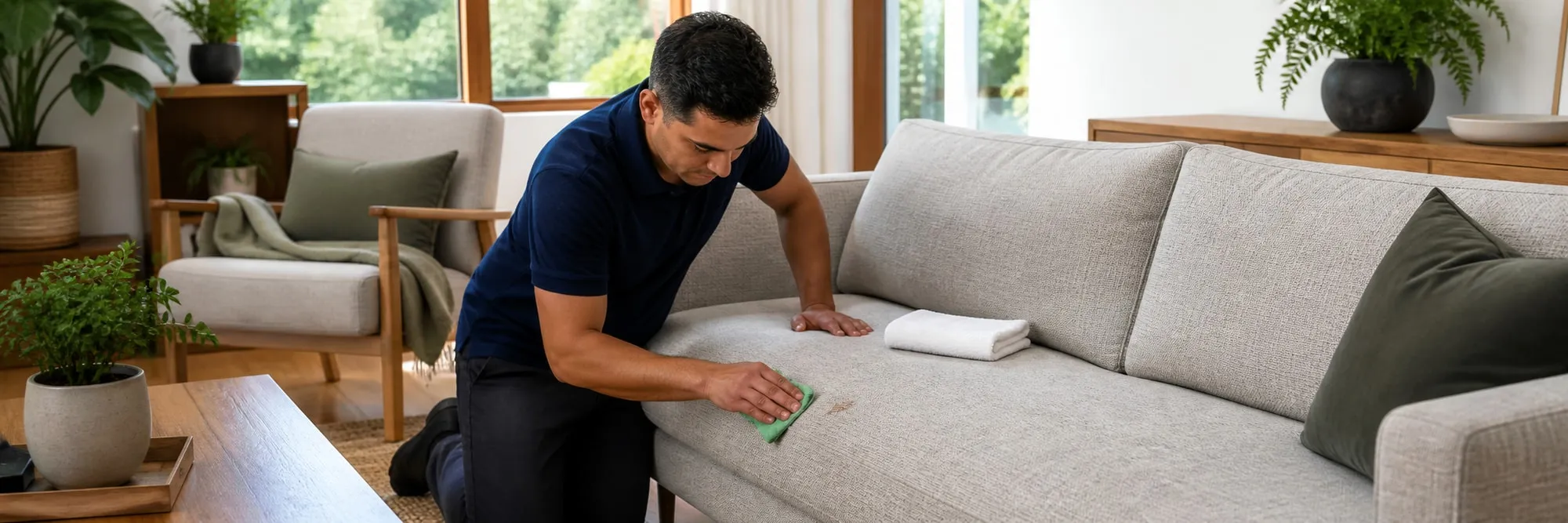
Most ruined couches we see weren't ruined by the spill. They were ruined by what happened next: a wet cloth, a good scrub, and a pale ring around the spot that's now more obvious than the mark ever was. Fabric couches aren't difficult to clean. They're just unforgiving about water. How much water yours can take is written on a tag under the cushions, and almost nobody looks.
That thing is a small tag with a letter on it. Start there.
Find the cleaning code on the tag before anything else. W means water-based cleaners are fine. S means solvent only, so water will mark it. WS means either. X means vacuum only. On a W fabric: vacuum thoroughly, test a hidden patch, then use a few drops of clear dish soap in warm water on a cloth wrung out until it's barely damp. Blot from the outside in, never scrub, rinse with a second damp cloth, and get it dry fast with a fan and an open window. If there's no tag, treat the fabric as unknown and test first.
Find the tag before you touch anything
It's a strip of white fabric, usually somewhere you have to look for it. Under the seat cushions is the most common spot. Otherwise try underneath the base, along the back of the frame, or stitched into a seam on the underside of a cushion cover.
What you're after is a single letter, or a pair of them. That letter is the manufacturer telling you what the fabric was tested against, which matters because it's set from the fibre, the weave and any finish that's been applied. A linen-look weave and a tight synthetic can look similar in a photo and behave completely differently once they're wet.
Worth being honest about the codes: they're a furniture-trade convention rather than a law, so they're not universal. Plenty of couches in New Zealand homes don't carry one at all, particularly second-hand pieces, older frames, and things that arrived flat-packed from overseas. The tag is the authority when it exists. When it doesn't, the hidden-patch test is.
What W, S, WS and X actually mean
- W is water-based. Ordinary water and a mild detergent are fine, which covers most of what people want to do at home. This is the most common code and the most forgiving fabric to own.
- S is solvent only. Water will leave a mark on it, sometimes permanently, even when the water is perfectly clean. If your tag says S, put the bottle of soapy water down.
- WS or SW means either method is acceptable. Start with the water-based option, since it's the gentler and cheaper of the two.
- X means no liquid at all. Vacuum and brush only. These are usually delicate or heavily textured fabrics where any wet cleaning distorts the pile, and there's no home method that gets around it.
The two that catch people out are S and X, because the instinct when something spills is to reach for water, and on those fabrics water is the damage. If you've got an S or X couch and something has gone into it, blot up what you can with a dry cloth and stop there.
Never mix cleaning products together, and that includes the household combinations people assume are harmless. Use one thing at a time, rinse between, and keep a window open. Solvent-based upholstery cleaners in particular need real ventilation and shouldn't be used near an open flame or a heater, so read the label on the tin rather than treating it like soapy water.
The method, step by step
This is for a W or WS fabric. It's deliberately boring, which is the point.
- 1. Vacuum properly first. Upholstery tool, into the seams, under the cushions, along the base. Cleaning over loose grit grinds it into the weave, and dry dirt becomes mud the second it meets water.
- 2. Test on a hidden patch. Back corner, or under a seat cushion. Then wait for it to dry completely before you judge it, because some fabrics only reveal a colour change once the water's gone.
- 3. Mix it weak. A few drops of clear dish soap in warm water. Not a squeeze. Strong solutions leave residue in the fibres and residue attracts dirt, so an over-soaped patch goes grubby faster than the fabric around it.
- 4. Work damp, never wet. Wring the cloth out until it's barely damp. If you can squeeze liquid out of it, it's too wet for upholstery.
- 5. Blot from the outside in. Start at the edge of the mark and work towards the middle, so you're pulling it inwards rather than spreading it. Blot, don't scrub. Scrubbing fluffs the fibres and leaves a worn patch that catches the light forever after.
- 6. Rinse with a second cloth. Plain water, wrung out the same way, over the area you've just done. This lifts the soap out. Skip it and you've traded a stain for a residue mark that comes back looking dirty in a month.
- 7. Dry it fast. Press a dry towel in hard to pull moisture back out, then get air moving with a fan and an open window.
If you're doing the whole couch rather than a spot, do a complete panel at a time. Cleaning half a seat cushion and stopping is how you end up with a clean patch that looks like a stain.
Over-wetting, and the ring it leaves behind
Over-wetting. It's the single most common thing we're called out to fix, and it's almost always someone being thorough rather than careless.
Here's what happens. Too much liquid goes in, spreads sideways through the fibres, and carries dissolved dirt with it to the edge of the wet area. As it dries, the dirt is left concentrated in a ring at the boundary. You've moved the problem outward and made it a shape. The original mark is gone and now there's a halo where it used to be.
Getting the moisture back out is half the job. Consumer NZ's guidance on carpet washers puts it plainly, and since that guidance covers upholstery as well as carpet, it applies directly here: avoid over-wetting and suck out as much moisture as you can, because shortening the drying time reduces the chance of stains, mould and musty odours developing.
That last part matters more here than it does in most countries. A couch holds a lot more water in its foam than a carpet does in its pile, and a New Zealand living room in July is not a fast-drying environment. Damp foam in a cold, closed-up room is exactly the condition mould wants, which we go into properly in our guide to mould on walls. A couch that smells musty a week after cleaning is usually a couch that never actually dried.
Attacking a fresh spill with a soaking wet cloth and a scrubbing motion. Both instincts are wrong in the same moment. The water spreads the spill and sets up a watermark, and the scrubbing damages the fibre so the patch stays visible even after the stain's gone. Blot, don't rub. Damp, not wet. If you do nothing else from this article, do that.
The marks worth trying, and the ones worth handing over
Some things come out easily at home if you get to them early. Tea, coffee, juice and most food spills lift with the damp-cloth method above, as long as you start before they dry. Speed matters far more than product here.
Grease is different, because water alone won't shift it. A little dish soap genuinely helps, since that's the job it's designed for, but keep the solution weak and rinse it properly.
Ink, dye transfer from new denim, pet accidents that have soaked into the foam, and anything that's been sat there for months are the ones where home attempts tend to make it worse rather than better. Consumer NZ keeps a useful A to Z stain removal guide that's worth a look before you experiment on the couch itself.
One that surprises people: sunscreen. It's oily, it contains pigments designed to stay put, and over a Kiwi summer it goes into the arm of the couch nearest the door. It's much harder to remove than the thing people worry about, which is usually red wine.
If it's the smell rather than the look
A couch that looks fine but smells is a different problem, and surface cleaning won't touch it. The smell is coming from the foam underneath, not the cover.
Vacuum thoroughly, including under the cushions and along the base where it collects. Baking soda left on the fabric for a few hours and then vacuumed off will take the edge off general staleness, and it's harmless on most fabrics. What it won't do is fix a couch that's absorbed a pet accident or a spilled drink down inside the cushion. That needs extraction, which pulls moisture back out rather than adding more, and it isn't something a cloth can do.
If the smell is stronger on a damp day, that's usually moisture in the foam rather than a stain, and it will keep coming back until the couch has properly dried out.
When it's worth handing over
Honestly, a lot of the time it isn't. A fresh spill, a bit of general grubbiness, or one mark on a seat cushion is an afternoon with a cloth. You don't need us for that, and we'd rather say so than take the booking.
It's worth getting someone in when:
- The whole thing has gone dull rather than spotted. Even soil across every panel is hard to fix by hand, because the challenge is doing it evenly, not doing it at all.
- The tag says S or X, or there's no tag and you can't identify the fabric with any confidence.
- Something has soaked through to the foam. Pet accidents especially. Extraction gets it out. Blotting the surface just moves it around.
- It's an expensive piece and the downside of getting it wrong is worse than the cost of not trying.
- You're moving out. Marked upholstery in a furnished rental is one of the things that gets picked up at the final inspection, and our bond-back guide covers what else gets checked.
What a professional clean actually gives you is hot-water extraction: solution goes in and comes straight back out under vacuum, so the fabric ends up far drier than anything you can achieve with a cloth and a bowl. That's the same principle behind carpet cleaning, and it's why the drying time is shorter, not longer, after a proper job. Our upholstery cleaning covers couches, dining chairs and armchairs, and if we think a mark isn't going to come out, we'll tell you that before you book rather than after.
If you'd rather tackle it yourself with a machine, our guide to using a Bissell spot cleaner goes through the over-wetting trap in more detail, since a machine makes it easier to put too much water in as well as easier to get it out.
General cleaning guidance only. Fabrics vary, and the manufacturer's tag or care instructions take precedence over anything here. Test any product on a hidden area first, and follow the safety directions on the label.