
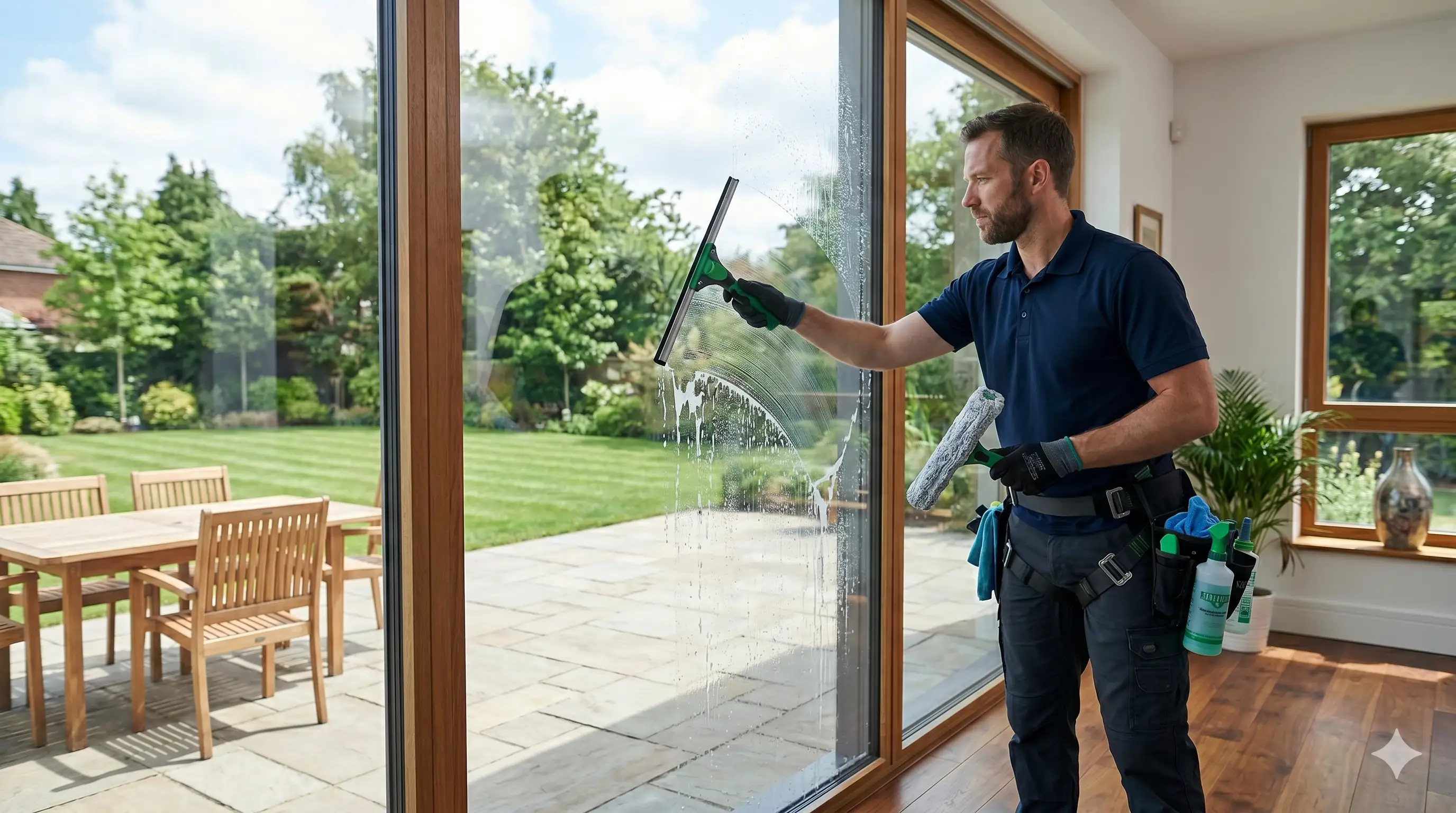
Clean windows are one of those jobs that look easy and then humble you. You wipe the glass, stand back, and it's covered in streaks that weren't there when it was dirty. The frustrating part is that the streaks are almost always something you've just done, not dirt you've missed. Get a few things right and streak-free glass is genuinely easy. Most of it comes down to when you clean, what you clean with, and how you dry.
Clean windows in the shade, never in direct sun. Use warm water with a couple of drops of dish soap, or a vinegar-and-water mix, and go easy on the product. Wash top to bottom, then dry straight away with a squeegee or a clean, dry microfibre cloth, finishing the edges with a separate dry cloth. Most streaks come from one of three things: cleaning in sunlight, using too much cleaner, or wiping with a dirty cloth. For upper-storey windows, a pole or a professional with the right gear is safer and gives a better finish than balancing on a ladder.
Why windows streak in the first place
Streaks are residue. Anything left on the glass after the water has gone shows up as a smear once the light hits it. Once you know that, the causes are obvious.
The big one is sunlight. Warm glass dries the cleaner before you've had a chance to wipe it off, so the solution and whatever it lifted dry onto the surface instead of coming away on your cloth. This is why the same method that streaks at midday works perfectly on an overcast morning. If you only change one thing, clean in the shade.
The second is too much product. People assume more cleaner means cleaner glass. It doesn't. Detergent that isn't fully removed dries as a film, and that film is what you're seeing. A little does the job, a lot guarantees streaks.
The third is the cloth. A cloth that's already full of grit or old detergent just moves the dirt around. Paper towels shed lint and break up on wet glass. Cotton rags can leave fibres and tend to smear rather than lift. Clean glass needs a clean, dry, lint-free cloth, and a fresh one once it's damp through.
Hard water plays a part too. In parts of the country with harder water, the minerals in tap water dry as their own faint spots. That's the problem the pros get around by using purified water, which is worth understanding on its own. More on that below.
How to clean windows without streaks
The method itself is simple. The discipline is in the drying.
- Pick the right time. Overcast, or a shaded side of the house. Avoid direct sun on the glass.
- Do the frame and sill first. Brush or vacuum the loose dust and dead insects out of the frame and tracks before any water goes on. Skip this and you turn dry dust into mud the moment you start washing.
- Mix a light solution. Warm water with two or three drops of dish soap in a bucket is plenty. For a lower-residue option, a mix of roughly one part white vinegar to ten parts water works well. You don't need a commercial spray, and you definitely don't need much of it.
- Wash top to bottom. A sponge or a damp microfibre cloth, starting at the top so the dirty water runs down onto glass you haven't done yet, not onto glass you've finished. Loosen any stuck-on spots with a bit of gentle work rather than more cleaner.
- Dry immediately, and properly. This is where streak-free is won or lost. The cleanest result comes from a squeegee: start at the top, pull down in slightly overlapping strokes, and wipe the blade with a dry cloth after every pass. No squeegee? A clean, dry microfibre cloth, turned often, does a good job on smaller panes. Buff in straight lines, not circles, so any missed bit is easy to spot.
- Finish the edges. The corners and edges hold the last of the water, and that's where the final streaks form. Run a separate dry cloth around the perimeter once the main pane is done.
If a faint haze remains, a quick buff with a dry microfibre clears it. The old newspaper trick works on the same principle, a dry, slightly textured material that buffs without adding lint, though modern newsprint and inks vary, so a microfibre is the safer bet.
The most common mistake we see is people spraying cleaner onto sun-warmed glass, then wondering why it dried streaky before the cloth arrived. The second is reaching for more product when the answer is almost always less.
A word on vinegar
Vinegar earns its reputation on windows. White vinegar cuts through the thin, greasy film that builds up on glass, and because it leaves very little residue, it dries clean. It's cheap, it's mild, and a weak solution does the job. Roughly one part vinegar to ten parts water, in warm water, is a sensible starting point, a little stronger for greasier glass like a kitchen window.
A couple of sensible limits. Keep vinegar off natural stone sills, since it's acidic and can etch stone over time. Be cautious around tinted or filmed glass, and only use what the film's maker recommends. And don't mix vinegar with other cleaners hoping for more power. You just get a worse result, and with some products, fumes you don't want.
Cleaning the outside, and the windows you can't safely reach
Outside glass is a different beast. It collects pollen, road film, salt spray near the coast, and general weather grime, so it usually needs a rinse before you wash. A hose to knock the loose dirt off first, then the same light solution and the same top-to-bottom, dry-as-you-go method.
Ground-floor exterior windows are well within reach of most people and worth doing yourself. The honest line is about height. Upper-storey windows, anything over a single level, or glass above a deck or a drop, are where people get hurt, and almost as often, do a worse job because they're stretched off a ladder with one hand. This is the point where it stops being a satisfying weekend job and starts being a safety question, and it's where reaching gear or a professional makes sense.
What pure-water cleaning actually does
If you've seen window cleaners working off a long pole with a brush on the end and no cloth in sight, that's pure-water cleaning, and it's worth understanding because it explains the finish.
Ordinary tap water has minerals dissolved in it. Those minerals are what dry onto glass as spots and light streaks, which is why tap water alone tends to leave a window looking worse, not better. Pure water has had those minerals stripped out through filtering, so there's nothing left in it to dry onto the glass. That does two things. It makes the water "hungry", so it actively lifts dirt off the surface, and it means the glass can be rinsed and then left to air-dry with no spotting and no wiping. No cloth, no squeegee, no streaks, because there's no residue left to leave a mark.
The other half of it is the pole. A water-fed pole carries that purified water up to the brush head, so a cleaner can reach second-storey and hard-to-access windows from the ground. That's safer than ladder work, and it reaches the awkward spots a ladder can't get to cleanly: the high gable window, the glass over the stairwell. It's the method we use for window cleaning on the upper-level glass, for exactly those reasons.
Double glazing, frames, and the fiddly bits
A few specifics that come up a lot.
Double glazing. You clean double-glazed windows the same way you clean any window: the outer and inner surfaces, with the light-solution-and-dry method above. The one thing you can't clean is the sealed gap between the two panes, and you shouldn't try. If you can see fog or condensation between the panes, that isn't dirt and it isn't a cleaning job. It means the seal of the unit has failed and moisture has got in, and the fix is reglazing or replacing the unit, not cleaning it. Worth knowing before you spend an afternoon trying to wipe away something on the inside of the glass.
Aluminium frames and the mould on them. Condensation is a fact of life in a lot of New Zealand homes, and it collects in the bottom of aluminium window frames and the rubber seals, where it turns to black mould. Wipe the frames down as part of the job, and for the mould, a mild cleaning solution and a scrub of the channels and seals usually lifts it. While you're there, clear the little drainage holes along the bottom of the frame, since blocked ones are part of why the water sits and the mould keeps coming back. Drying the sills after condensation forms is the longer-term fix.
Brass window fittings. Older homes often have brass latches, stays and handles. If they're bare brass and have dulled, a dedicated brass or metal polish brings them back, applied with a soft cloth and kept off the surrounding paint and timber. Go gently, and don't take abrasive pads to them. If the brass is lacquered, a wipe with a damp cloth is all it needs, since polish can damage the coating.
Tracks and sills. Vacuum the grit out of the runners first, then wipe. Same principle as the frames: get the loose dirt out dry before anything wet goes near it.
Do tenants have to clean the outside windows?
If you're renting, this one's worth knowing, because it comes up at the final inspection. The short answer is yes, within reason.
Tenancy Services is clear that tenants can be expected to do outside cleaning tasks like window cleaning, because tenants are responsible for keeping the property reasonably clean and tidy. The key word is accessible. The responsibility only applies to windows you can reasonably reach, and it does not extend to the windows of apartment buildings or multi-level houses, which fall to the landlord. Tenancy Services also suggests agreeing who does what at the start of the tenancy and noting it on the agreement, which saves the argument later.
So: reachable ground-floor glass, yes, leave it reasonably clean like the rest of the place. The high windows you'd need a ladder or specialist gear for are not your problem. If you're working through a full move-out, our guide on how to get your bond back covers what actually gets checked and where the "reasonably clean" line sits.
When it's worth getting a pro in
Plenty of window cleaning is a good weekend job, and there's real satisfaction in a clean pane you did yourself. The ground-floor windows, the inside glass, the doors: do those yourself and the method above will get you there.
It's worth getting someone in when:
- There's height or awkward access. Upper-storey windows, glass over a drop, or anything you'd need a ladder for. This is the safety one, and it's the main reason people call.
- There's a lot of glass. Big runs of windows, a whole house, or a lot of joinery turn a quick job into a long one.
- The water's against you. Hard-water staining and mineral spotting that won't shift by hand often need purified water to clear properly.
- It needs to be consistent. Before a house goes on the market, or at the end of a tenancy, when you want every pane done to the same standard without doing it yourself.
Spruce cleans interior and exterior windows, with pure-water poles for the upper-level glass that's awkward or unsafe to reach by ladder. You can get a fixed price online in under a minute on our pricing page, and we guarantee the clean, so if something's been missed, we come back and put it right.