
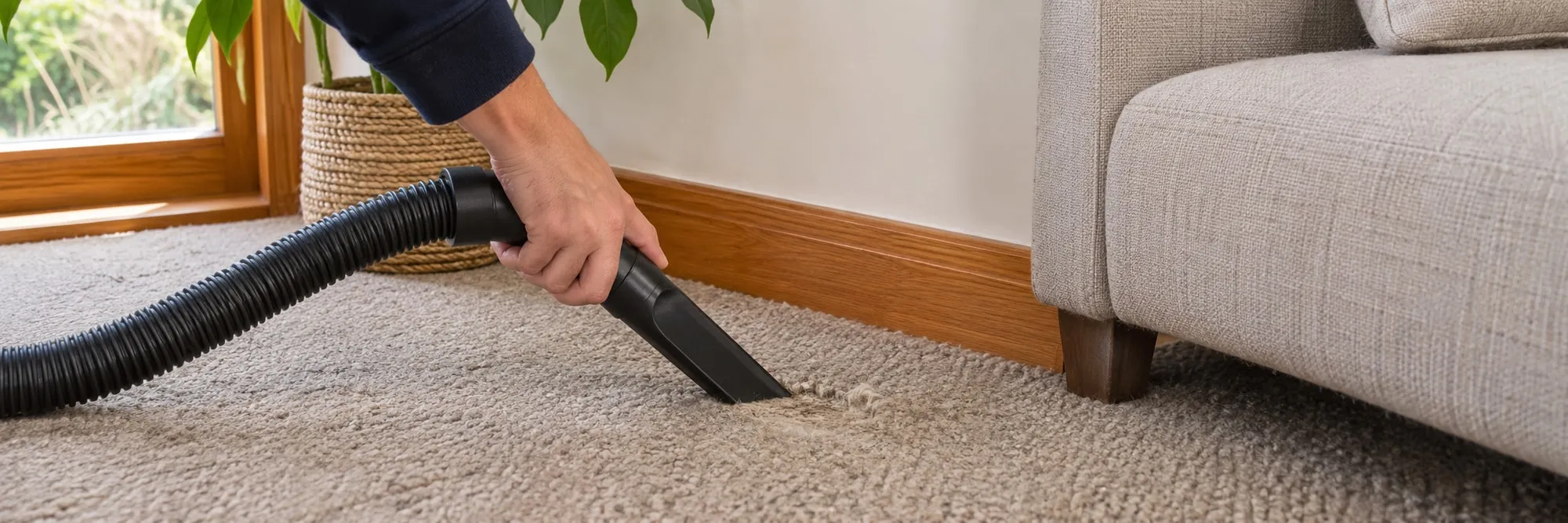
Most people find out they've got carpet moths the same way. They move the couch, or pull out a bed, and find a patch of wool carpet that's gone thin and bald in a neat shape along the wall. The little moths flitting around the room were the clue that was missed. If you want to know how to get rid of carpet moths, the most useful thing to understand is that you're not really fighting the moths at all. You're fighting the larvae they left behind in the pile.
Here's the short version, then the detail.
The damage is done by the larvae, not the moths you can see, and the larvae live where the carpet doesn't get disturbed: along the edges, under furniture, behind doors. Vacuum those places hard and bin the contents outside straight away. Follow fabric care labels before hot washing or freezing affected items, and get the carpet deep cleaned to lift out what the vacuum misses. Use a suitable pheromone trap alongside inspection to monitor activity, not as the fix or proof they're gone. If it's through several rooms or keeps coming back, that's a job for a pest controller.
It's the larvae, not the moths
This is the part almost everyone gets backwards, so it's worth being plain about. The adult moths don't eat your carpet. The University of California's pest guidance puts it simply: the larva is the damaging stage. The moths are there to breed, and the larvae are what hatch and feed.
What they feed on is animal fibre. The same guidance lists wool clothing, carpets and rugs, upholstered furniture, furs and stored wool among the things clothes moth larvae eat. That's why "carpet moth" and "clothes moth" are really the same problem wearing two names, and why finding them in the carpet is a good reason to check the wardrobe, the wool rugs and the couch as well.
It's also why a synthetic carpet in one room can be untouched while the wool rug next door is being eaten. They're not choosing the dirtier room. They're choosing the food.
If what you find in the damaged patch is a tiny, hairy, brown grub with dark bands and a brush of hair at the tail end, it may not be a moth at all. That's how the museum conservation guide What's Eating Your Collection describes the larva of the Australian carpet beetle, which grows to about 5mm and eats wool, fur and feathers. Manaaki Whenua's New Zealand bug identifier has an entry for carpet beetle if you want to check what you've got. Either way, the clean-up starts in the same place: find where they're feeding and get it out of the pile. If the signs point to beetles, our carpet beetle clean-up guide covers identification, larvae and the next steps.
Where they hide
Larvae don't like being disturbed, so look first in the hidden parts of the room rather than only the open floor. They're in the spots that don't get touched from one month to the next.
The University of California guidance notes that damage generally turns up in hidden places, including the crevices of upholstered furniture and carpeted areas beneath furniture. In a New Zealand house that usually means:
- Along the skirting boards, where the vacuum head doesn't quite reach
- Under beds and couches, especially heavy ones that never get moved
- Behind doors that sit open against the carpet
- Spare rooms that get shut up over winter and hardly walked in
- Wool rugs and sheepskins that stay in one spot, and the carpet underneath them
- Rugs rolled up in storage, in the garage or under a bed
The pattern to look for is a patch that's gone thin or bare, often with a clear edge where the furniture stops. Light foot traffic keeps them away from the rest of the room, which is why a busy hallway can be untouched while the corner behind the bookcase is gone.
How to get rid of carpet moths
Do these in order. The first three are the ones that do most of the work, and you can do all of them yourself.
- 1. Find where they're feeding. Check the edges of rooms, under beds and couches, behind doors, and any rug or sheepskin that doesn't get moved. Larvae stay out of sight, so the damage shows up in the hidden, undisturbed spots first.
- 2. Vacuum hard, especially the edges. Go slowly along the skirting, under and behind furniture, and into the corners, not just the open floor. Vacuuming lifts eggs, larvae and adults out of the pile.
- 3. Empty the vacuum straight away. Empty the canister or remove the bag and put the contents in the outside bin immediately, since it can hold eggs, larvae and moths.
- 4. Wash what you can, hot. Wash affected rugs, throws and wool items that can take it in water at least 49°C for 20 to 30 minutes. Only use a hot wash when the care label allows it; delicate wool may need a suitable dry cleaner.
- 5. Freeze what you can't wash. For items that can safely be frozen, the University of California guidance specifies a sealed bag, several days and a temperature below -8°C. Check the fabric can tolerate the method and that the freezer holds the required temperature.
- 6. Get the carpet deep cleaned. A hot water extraction clean reaches much deeper into the pile than a vacuum and lifts out the debris and larvae that vacuuming leaves behind.
- 7. Monitor for the next few months. Put a pheromone trap in the affected room. Check it alongside live larvae and new damage. An empty trap doesn't prove they're gone.
If the couch is involved, it needs the same treatment as the carpet: vacuum the crevices and under the cushions, then look at what the fabric can take. Our guide on how to clean a fabric couch covers the tag codes, and for anything that can't be washed or needs a deeper clean, there's upholstery cleaning.
Do moth traps work?
They work, just not at the job most people buy them for.
A pheromone trap attracts male moths. The University of California guidance says trapping lets you detect moths and gives some control, because trapped males can't mate, but that if you trap moths you should also take other measures. In other words, a trap is a very good way of finding out you've got a problem, and a useful part of follow-up monitoring alongside inspection. It does nothing about the larvae already in the carpet.
Chasing the moths you can see. Someone spots them flitting around the lounge, sprays them or puts up a trap, watches the moths disappear, and thinks it's sorted. Meanwhile the larvae carry on eating along the wall behind the couch, and the next batch of moths turns up a few months later. The moths are the symptom. Vacuum the edges and move the furniture, or you haven't really started.
Keeping them out
Once they're gone, keeping them away is mostly about not giving them the undisturbed, dark spots they need.
- Vacuum the edges regularly, not just the middle of the room. Our guide on how often to clean carpets covers a sensible rhythm for the deep cleans between.
- Move the furniture now and then. Even shifting a couch a few times a year disturbs the spot underneath enough to matter.
- Air the spare room. Open it up and walk through it over winter rather than shutting the door on it for months.
- Store wool clean and sealed. The University of California guidance notes that fabrics with food, sweat or urine stains are more prone to damage, and that anything going into storage should be clean, pest-free and in an airtight container. That goes for a rolled rug, a sheepskin and the winter jerseys alike.
- Check the label when you buy. Consumer NZ advises that wool carpet needs to be chemically treated against moths and insects, and to check the label to see it's been treated to resist insect damage. It also notes that synthetic fibres resist insect damage.
When it's a pest control job, not a cleaning one
Here's the part that costs us work, and it's worth saying plainly.
If you've caught it early, one patch behind the couch, one rug, the steps above and a good carpet clean will usually sort it. But if it's through several rooms, keeps coming back after you've cleaned, or you're finding damage in places you can't get to, you need a pest controller. That's a treatment job, and cleaning on its own won't get there.
We won't tell you a carpet clean kills carpet moths, and we'd be wary of anyone who does. A hot water extraction clean lifts a lot of what's living in the pile, and it's a strong part of the clean-up. But the guidance for killing larvae in washable items is water at 49°C for 20 to 30 minutes, and a carpet clean passes over any one spot in seconds. So it's one step in getting rid of them, not the whole fix. We'd rather say that than book a clean that won't solve your problem.
Where a clean does make a real difference is either side of treatment. Before, it gets the carpet clear so the treatment can reach what it needs to. After, it lifts out the debris and leaves you with a clean baseline, so a trap that stays empty actually means something.